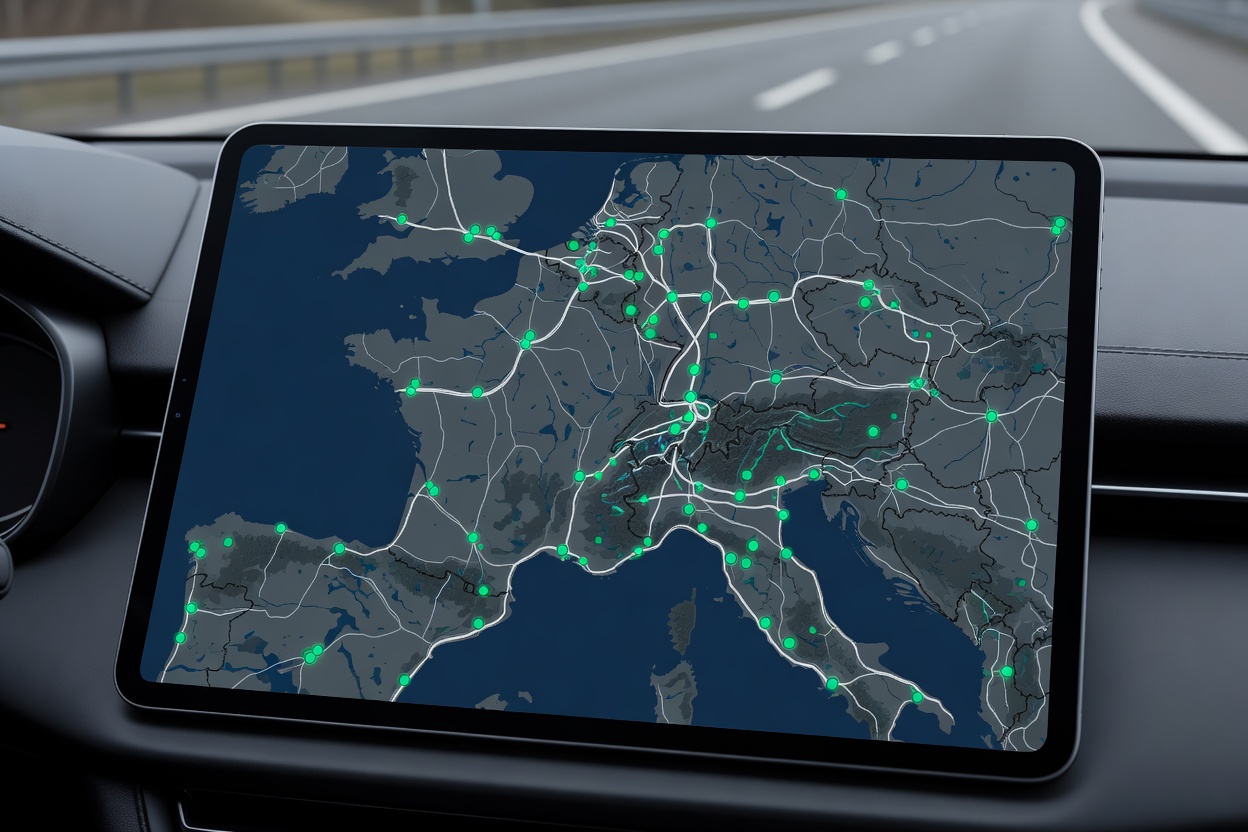
The Fundamental Shift from Miles to Kilowatt-Hours
When driving a traditional petrol or diesel car across Europe, drivers rarely think about energy reserves until the low-fuel indicator illuminates. Refuelling stations are omnipresent, liquid transfer takes three minutes, and fuel pumps consistently deliver fuel at an identical flow rate regardless of outside temperature or vehicle tank capacity.
Electric touring is fundamentally different. Electric vehicle road-trip planning revolves around usable battery capacity (measured in kWh), variable high-power DC acceptance rates, and external environmental drag factors. Instead of treating stops as inconvenient delays, experienced EV tourers structure daily itineraries so charging occurs while resting, dining, or walking through a historic town centre.
Estimating Usable Range on European Motorways
Official laboratory range figures, such as the European WLTP (Worldwide Harmonised Light Vehicles Test Procedure), provide an equitable baseline for comparison between models, but they reflect mixed urban and gentle suburban cycles. When cruising continuously at 120 km/h to 130 km/h on France's Autoroutes or Germany's Autobahnen, aerodynamic drag increases exponentially with the square of speed.
For realistic touring planning, establish your vehicle's Highway Consumption Factor. For example, a medium crossover rated at 17 kWh/100 km in mixed driving may require 22 to 25 kWh/100 km at sustained motorway speeds, rising further in headwind conditions or sub-zero ambient temperatures.
Furthermore, you rarely use 100% of your battery during cross-country driving stages. Because DC fast-charging speeds slow substantially above 80% State of Charge (SoC), your usable highway cycling window is normally between 10% and 80%—meaning only 70% of total battery pack capacity is utilised between charging sessions.
Motorway Corridors vs Scenic Regional Routes
When plotting your route, compare toll motorways with secondary routes. High-speed motorways boast the densest concentration of multi-stall ultra-rapid charging hubs (often with 6 to 24 stalls per plaza), reducing waiting risk. However, they consume battery energy at the highest rate.
In contrast, secondary national roads (such as France's Routes Départementales or Germany's Bundesstraßen) feature lower speed limits (typically 70–90 km/h), frequent deceleration that harvests energy via regenerative braking, and significantly reduced aerodynamic resistance. While chargers on regional roads are often slower 50 kW units or twin 22 kW AC posts, the vehicle consumes significantly less energy, extending physical distance per charge.
Managing Weather, Elevation, and Passenger Load
Three physical variables determine real-world travel range:
- Ambient Temperature: Cold air is denser, increasing aerodynamic drag. Simultaneously, lithium-ion electrolyte viscosity rises, and cabin heating can demand 1.5 to 3 kW of continuous battery power unless your vehicle is equipped with a heat pump.
- Elevation Gain: Lifting a two-tonne vehicle over a mountain pass consumes substantial energy. Always check topographic route charts. While descending returns up to 70% of energy through regeneration, running out of charge before cresting the summit will strand you.
- Aerodynamic Additions: External accessories such as roof cargo boxes or rear bike racks increase the drag coefficient dramatically, reducing highway range by 15% to 30%.
Redundancy and Buffer Management
The cardinal rule of electric trip planning is the 15% Arrival Buffer. Never plan a transit stop that projects an arrival SoC under 10% unless you have verified that the charging hub has at least four independent stalls and nearby alternative facilities.
If high winds, unexpected motorway detours, or colder temperatures increase consumption during a leg, adjust immediately: drop cruising speed by 10 km/h to save substantial energy, or use in-car navigation to add an earlier top-up stop before battery reserves dip into critical territory.
Pre-Departure Route Planning Checklist
- Verify usable 70% cycle: Calculate distance legs based on 10% to 80% battery capacity rather than 0% to 100%.
- Scout backup plazas: Identify a secondary charging location 20 to 30 km before your scheduled stop.
- Check multi-stall availability: Select charging hubs with at least 4 to 8 high-power plugs to minimise queue delays.
- Confirm destination charging: Verify if your overnight hotel has operational AC Type 2 wallboxes and whether advance reservation is necessary.
- Pre-condition batteries: Input rapid charging destinations into vehicle native navigation so the pack pre-heats for optimal speeds.
Good For
- Leisurely family road trips with structured rest intervals every 2.5 to 3 hours.
- Touring regions with dense multi-stall motorway hubs (e.g. Netherlands, Germany, Scandinavia).
- Maximising overnight hotel stops to start every morning at 100% SoC.
What to Know
- Strict time-sensitive journeys may require planning for potential peak-hour charging queues during summer holidays.
- Isolated mountain or rural regions require checking charger operational status before departure.
- Cold winter weather reduces real-world highway range; plan shorter travel intervals.
Need Route Advice or Have Updated Information?
Our editorial team welcomes constructive feedback on European EV routes and infrastructure developments.
Contact the Editorial Team