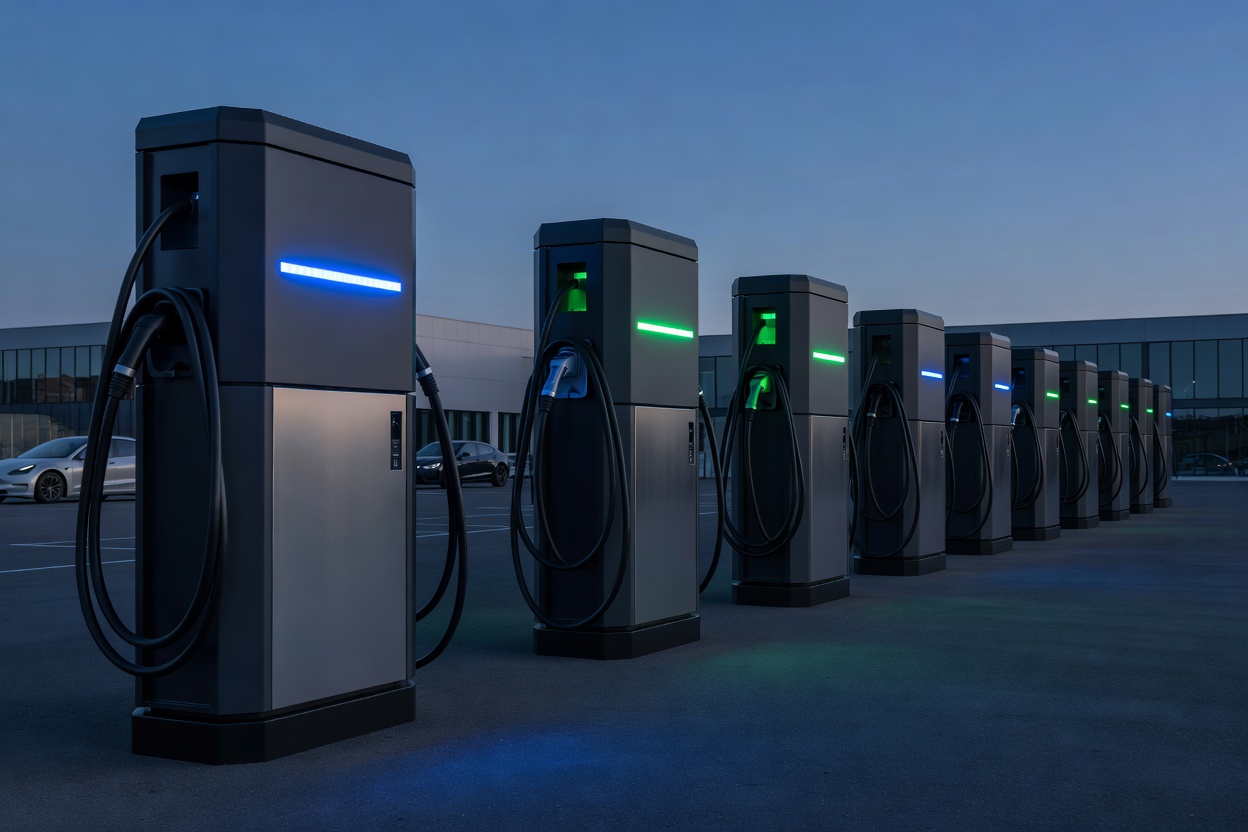
AC vs DC: Understanding the Core Electricity Distinction
When travelling in Europe, you will encounter two fundamental classes of electric vehicle charging: Alternating Current (AC) and Direct Current (DC). Understanding this distinction prevents costly delays and incorrect stop planning.
The chemical cells inside an electric car's traction battery can only store direct current (DC). Domestic electrical grids and standard public sockets supply alternating current (AC). Therefore, when plugging into an AC post—such as a street bollard or a hotel wallbox—the vehicle's internal on-board charger must convert AC into DC. Most modern electric cars feature on-board AC chargers rated at 11 kW (with some entry models at 7.4 kW and selected models supporting 22 kW). Plugging an 11 kW vehicle into a 22 kW AC post will still only charge at 11 kW.
In contrast, high-power DC fast chargers (often rated between 50 kW and 350 kW) perform this heavy power transformation within the stationary roadside cabinet. The station delivers DC current directly into the battery pack via heavy liquid-cooled cables, bypassing the vehicle's onboard AC converter and cutting charging times dramatically.
The Charging Curve: Why 150 kW Does Not Mean 150 kW Throughout
One of the most common surprises for new electric tourers is discovering that a charger rated at "300 kW" does not deliver 300 kW from empty to full. How fast electricity enters the battery is dictated entirely by your vehicle's Battery Management System (BMS), known as its charging curve.
When a battery is at 10% SoC and warmed to its optimum operating temperature (usually around 25°C to 30°C), internal chemical resistance is low, allowing peak kilowatt intake. As the battery fills, resistance increases and cell voltage rises. To prevent lithium plating and overheating, the BMS progressively steps down the power intake.
By 80% SoC, charging power on many vehicles falls to 30–50 kW, and above 90% it can slow to under 15 kW. Consequently, charging from 80% to 100% can take as long as charging from 10% to 80%. On road trips, disconnecting at 80% and proceeding down the motorway is almost always the quickest strategy.
European Connector Standards
Infrastructure across the European Union and the UK is highly standardised:
- Type 2 (Mennekes): The statutory European standard for AC charging. Public AC posts require you to supply your own untethered Type 2 cable (typically 5 to 7 metres long).
- CCS2 (Combined Charging System Type 2): The undisputed European continental standard for DC rapid charging. CCS2 cables are permanently attached to rapid charging stations.
- CHAdeMO: The legacy DC standard primarily used by earlier Japanese electric cars. CHAdeMO support is gradually being phased out at new motorway charging hubs.
Payment Methods, Roaming Cards, and Apps
European charging networks do not operate as a single consolidated utility. Hundreds of regional Charge Point Operators (CPOs) manage hardware across national borders. While the European Union's AFIR regulations now require ad-hoc payment terminals (debit and credit card contactless) on new high-power charging installations, older chargers and rural AC posts often require an app or RFID card.
The most reliable road-trip approach is to obtain accounts with two major independent European e-Mobility Service Providers (eMSPs) before departure. These provide a physical RFID card that roams across tens of thousands of chargers across different operator networks. Physical RFID cards are critical in underground parking garages, Alpine valleys, or border regions where smartphone cellular reception can fail.
Destination and Hotel Charging
The easiest charging of all is charging while you sleep. Hotels, rural guesthouses, and apartments with dedicated AC wallboxes allow you to arrive in the evening with 10% and awaken with 100% capacity. Because hotel charging uses gentle AC power over 6 to 8 hours, it causes zero thermal stress to the battery pack and eliminates morning motorway queues.
Charging Strategy Checklist
- Order physical RFID cards: Secure two separate cross-border roaming cards at least two weeks before travel.
- Pack your Type 2 cable: Ensure a 32A three-phase Type 2 cable is packed accessible in your luggage area.
- Arrive with a low, warm battery: Aim to reach high-power DC hubs below 20% SoC with navigation pre-conditioning active.
- Target the 10-80% window: Move on when your vehicle reaches 75% to 80% to save valuable travel time.
- Confirm parking rules: Check for idling penalty fees that trigger after charging completes at busy urban hubs.
Good For
- Motorway service areas featuring 6 or more high-power CCS2 plugs.
- Overnight stops at hotels with pre-bookable Type 2 parking spaces.
- Vehicles with high peak charging rates (150 kW+) and flat charging curves.
What to Know
- Single-stall municipal chargers are prone to being occupied or out of service.
- Roaming tariffs vary significantly between networks; check per-kWh pricing in your eMSP app.
- Cold winter weather without pre-conditioning can cut initial charging speeds in half.
Questions on European Charging Standards?
Our editorial team tracks network updates, roaming passes, and charging protocols across the continent.
Contact the Editorial Team